
At University I was taught that the speed of light is constant. Light would approach you at the same speed if you were moving away from a source as if you were moving toward it.
It was never explained why.
I was also taught that the only way to understand the dynamics of space was by measurement, and that therefore moving clocks between observers and the effect on measured time of this movement gives rise to the understanding of space-time that emerges in Relativity. Was the nature of reality contingent on humans shuffling clocks around the universe? At the time, I didn’t think that was very convincing and in truth, with more important things to occupy or otherwise distract my mind, I didn’t think about it very much again.
Until that is, strolling through Kew Gardens (by now perhaps some twenty years later) I tried to reconstruct the argument about how relativity and clocks are related. It still seemed to be a theory that had put the cart before the horses.
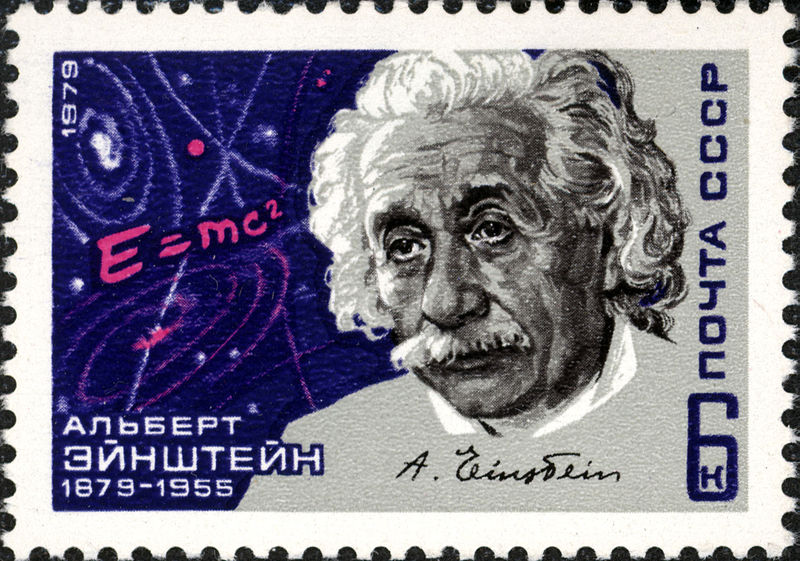
USSR Stamp 1979
In order to measure an amount of time elapsed in a spacecraft moving away from you (you might wish to do this, for instance, to calculate its velocity) it would be necessary to make some measurement of a time interval on the spacecraft, and then compare it to the measured time for the same interval here on earth. So far so …well…. obvious. We would all expect the two times to be the same, wouldn’t we? You could agree with the spaceman to start his clock as he took off and to let you know when (say) half an hour had elapsed (on his clock) and see if that corresponded to the same thirty minutes on your own terrestrial clock.
But, or so the argument runs, although the astronaut sends his signal immediately his half hour is up, it would take additional time for his signal to travel back here to earth before we received it. This ‘additional time to communicate with us’ when added to the measured time of thirty minutes on our clock here, would suggest that his clock was running slow. We have thirty minutes showing, we only get a signal from him after forty minutes (say). Our ‘thirty’ is equivalent to his forty’ therefore his clock is running slow.
Was that it?
But…isn’t that …how shall I put it…..bo***cks??!!
Sure we have a measurement problem. Sure we may have an epistemological problem – but is that really enough to conclude his clock is running slow?
I don’t think so.
‘You may regard this as counter-intuitive, but hey…who said that an intuition carefully evolved to deal with our sensory perceptions in the everyday world is any sort of guide when we’re dealing with phenomena outside our experience e.g. speeds approaching the speed of light? Who said the laws of physics need please us? Do the experiments – that is after all, the scientific way – and you will find that THIS IS HOW IT WORKS. THE ASTRONAUT’S CLOCK DOES RUN SLOW’.
They normally chuck in something about calibrating the GPS system too, for good measure.
That’s it then – it’s clearly my problem – not theirs.
Philip was interviewing a Professor Of Physics at Flinders University, Reg Cahill, and Reg made some astonishing assertions.
- For the most part Relativity works because there are relativistic effects (matter contracting with increased speed), but these are actual physical transformations, not perspectives depending on viewpoint.
- There is such a thing as ‘time’ with a ‘now ‘moment – it is not merely some psychological effect – but is as we intuitively understand it. There is ‘simultaneity’ across the universe.
- Space is not simply the absence of anything – it is made of ‘stuff’, against which the speed of light can be measured.
- All of these assertions were (relatively!) easy to demonstrate, and the maths was there for anyone to check.
This was music to my ears.
For good measure, Reg added that he was working on a new physics that accounted for all the evidence, including several results that Relativity cannot explain.
He called this new science – Process Physics.


